Ohio Revised Code § 2945.38
The Minds of Billy MilliganOhio Revised Code § 2945.38 mattered in Milligan’s case because its wording appeared to leave room for a hospital other than Lima State Hospital. The defense read that possibility as a way to secure psychiatric examination and treatment at Harding Hospital, within the court’s jurisdiction. The provision thus became more than legal text: it offered a practical alternative during a dispute over where Milligan could be sent, while also illustrating that a diagnosis, a finding about responsibility at the time of an offense, and a decision about hospitalization were separate questions.
The provision and its practical opening
The passage read in the book describes what could happen if a court or jury found a defendant not sane: the person was to be committed to a hospital for the mentally ill within the court’s jurisdiction. It also allowed the court, if it considered that advisable, to commit the person to Lima State Hospital until the person was restored to reason. The significant distinction for the defense lay between a hospital within the court’s jurisdiction and Lima as a specific option. The text did not, as Gary understood it, make Lima the only possible destination.
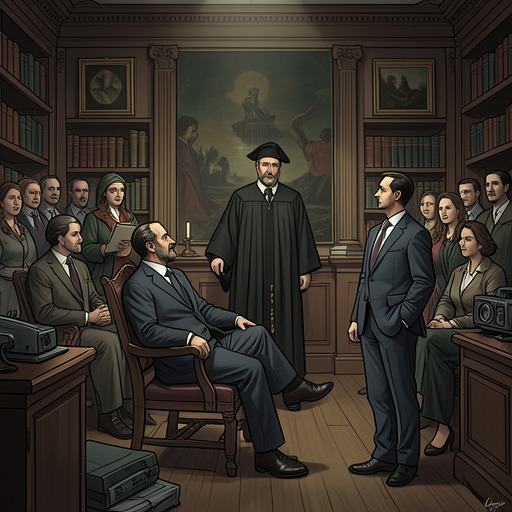
The defense discovered this possibility while consulting the Ohio Criminal Law Handbook. Judy Stevenson read the relevant section aloud, and Schweickart seized on the phrase allowing commitment to a hospital within the court’s jurisdiction. He had previously worked as a psychiatric aide at Harding Hospital, in Worthington, Ohio, and knew it was within that jurisdiction. His knowledge of the hospital’s standing strengthened the proposal: he described it as a conservative and respected institution whose judgment would carry weight with prosecutors. The statute supplied the legal opening; Schweickart’s firsthand familiarity identified a specific hospital that might fit it.
Examination and the dispute over information
The search for a suitable hospital formed part of a broader dispute over how Milligan’s mental condition should be assessed and what could be done with the results. After Schweickart and Judy Stevenson continued visiting him in prison despite his letter firing them, the public defender’s office funded a psychological evaluation. On January 8 and 13, 1978, clinical psychologist Willis C. Driscoll administered tests. He reported an IQ score of 68, while cautioning that depression had lowered it, and diagnosed acute schizophrenia. His report described severe difficulty distinguishing self from environment, voices Milligan experienced as commanding or tormenting him, and his belief that good people entered his body to oppose bad ones. Driscoll concluded that Milligan could not then assist adequately in his defense and recommended hospitalization for further examination and possible treatment.
On January 19, Stevenson and Schweickart presented Driscoll’s report to Judge Jay C. Flowers to support their claim that Milligan could not assist in his own defense. Flowers directed the Southwest Community Mental Health Center in Columbus to assign its forensic psychiatry unit to examine him. The defense worried that this unit would be aligned with the prosecution. Schweickart therefore insisted that information disclosed during the examination be privileged and not used against Milligan. The prosecutors resisted, and the dispute brought the defense close to being held in contempt. The eventual compromise allowed questioning about incriminating statements only if Milligan later took the stand in his own defense. The lawyers accepted that limited protection and permitted the examination to proceed.
This episode clarifies what the statutory discovery did and did not settle. Driscoll’s report addressed Milligan’s then-current capacity to understand events and assist counsel; the proposed forensic examination raised questions about the use of information gathered during that assessment. Neither the diagnosis nor the location of an examination, by itself, determined whether Milligan was criminally responsible for earlier conduct. The statute’s practical importance lay in the institutional route it appeared to permit, not in establishing a clinical diagnosis or deciding guilt.
Harding Hospital and the consequence of the reading
The alternative identified through the handbook became concrete when Milligan was transferred from the Franklin County Jail to Harding Hospital on March 16, two days earlier than scheduled. Dr. George Harding was away at a psychiatric meeting in Chicago, so Dr. Shoemaker agreed to take personal charge until he returned. Judy Stevenson and Dorothy Turner followed the police car and accompanied Milligan to Wakefield Cottage, a locked psychiatric unit for difficult patients needing constant observation and personal attention. He was placed in a special-care room with a peephole for around-the-clock observation. The transfer gave practical effect to the search for treatment outside Lima, although the statutory passage alone does not establish every legal basis for the hospital placement.
The choice of Harding did not mean that the legal questions were over. Milligan’s later trial concerned his mental condition at the time of the charged acts. Judge Flowers dismissed the first rape count for lack of corroborating evidence and a similar modus operandi. On counts two through ten, the stipulated medical evidence led Flowers to find that Milligan had been mentally ill during the offenses, unable to distinguish right from wrong, and unable to refrain from the acts; the court found him not guilty by reason of insanity. That ruling answered a question about criminal responsibility at the time in question, not the separate question of where he should receive treatment.
Later decisions and the rule’s significance
The distinction remained important after the acquittal. At Athens, Dr. David Caul told Milligan that the trial was over and framed recovery as a new process involving his work with Billy and the effort to bring himself together. Later, during proceedings concerning continued hospitalization, the court’s December 10, 1979 findings described Milligan as mentally ill, identified his condition as multiple personality, and cited risks of harm to himself and others as grounds for hospitalization and treatment. Those findings belong to a later commitment decision; they should not be collapsed into the earlier reading of Ohio Revised Code § 2945.38 or treated as the same determination as the insanity acquittal.
The section’s importance in the narrative is therefore procedural and specific. Its wording gave the defense a reason to challenge the assumption that Lima was the sole available hospital, and Schweickart’s experience turned that reading into a proposal for Harding Hospital. The subsequent course of the case makes the limits of that opening visible: choosing an examination or treatment setting did not resolve whether Milligan could assist in his defense, whether he was responsible for the charged acts, or whether he later met the grounds for court-ordered hospitalization. The provision marks one point where close reading of law altered the available path through a much larger clinical and criminal process.